
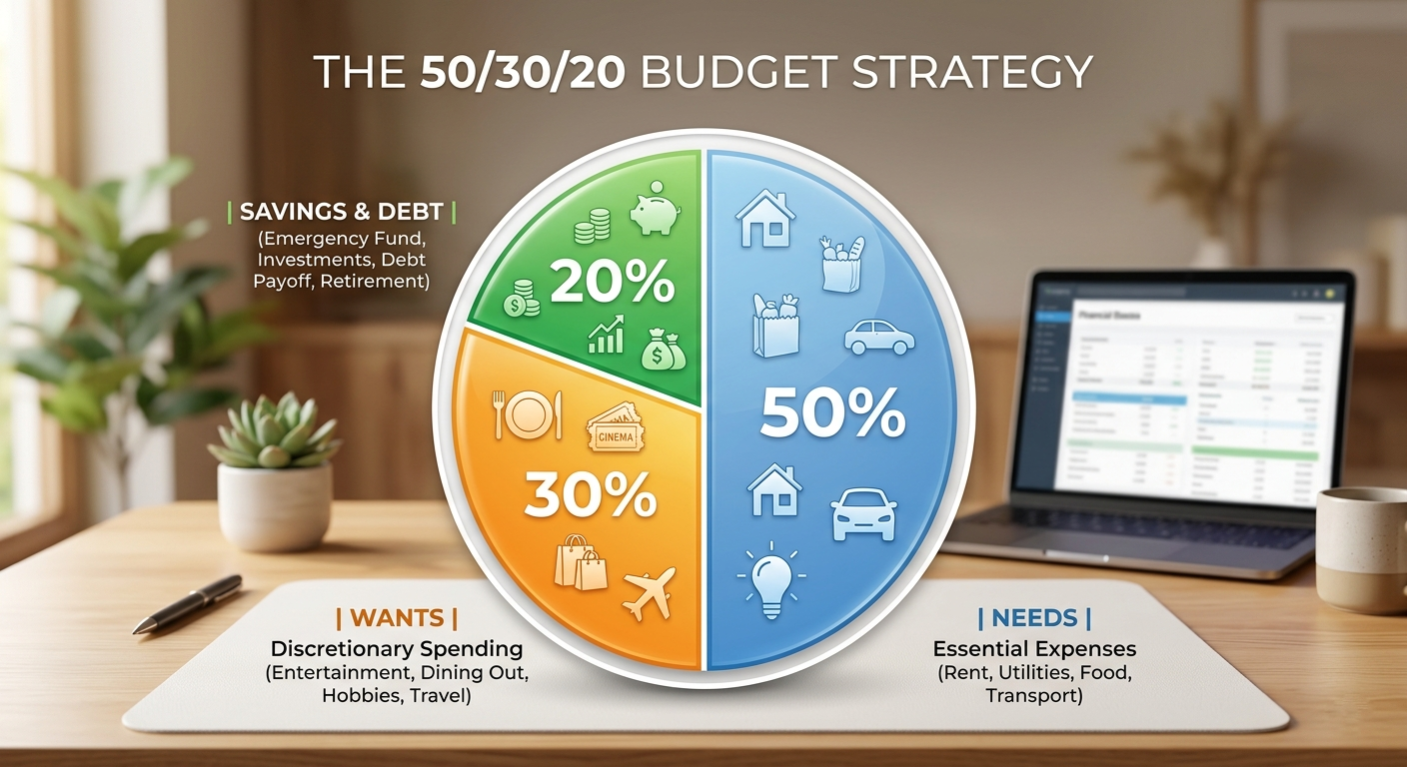
Most people treat the word “budget” like a four-letter word; it sounds restrictive, boring, and bound to fail. But what if your financial plan wasn’t a cage but a roadmap? Enter the 50 30 20 budget strategy, a straightforward financial framework designed to help you balance your lifestyle today with your security for tomorrow.
Originally popularized by Senator Elizabeth Warren in her book All Your Worth, this percentage-based budgeting method has become a gold standard for anyone seeking financial wellness without the headache of tracking every single penny. Unlike traditional line-item budgets that require constant monitoring, the 50/30/20 rule simplifies your personal finance management by dividing your after-tax income into just three easy-to-manage categories.
Whether you are a budgeting for beginners enthusiast or a seasoned saver looking to optimize your monthly cash flow, understanding this strategy is the first step toward building a sustainable money management habit. In this guide, we’ll break down exactly how to allocate your paycheck, distinguish between “needs” and “wants,” and finally hit those savings goals that have felt out of reach.
Quick Breakdown: The 50/30/20 Rule at a Glance
- 50% to Needs: The essentials you can’t live without.
- 30% to Wants: The lifestyle choices that make life fun.
- 20% to Savings: Your “future self” fund for debt repayment and investments.
What is the 50 30 20 Budget Strategy?
At its core, the 50 30 20 budget strategy is a proportional budgeting method. Instead of obsessing over whether you spent $5 too much on coffee this week, you focus on the “big picture” of your take-home pay.
By allocating fixed percentages to your expenses, you create a balanced financial plan that covers your present obligations while fueling your future wealth building. To make this work, you must calculate your totals based on your net income—that is, the amount that actually hits your bank account after taxes and payroll deductions.
The 50%: Must-Have Needs
The first and largest slice of the pie is dedicated to your essential expenses. These are the non-negotiables—the bills that, if left unpaid, would severely impact your quality of life or legal standing.
Under the 50/30/20 rule, your “Needs” should ideally consume no more than half of your after-tax income. Common items in this category include:
- Housing: Rent or mortgage payments, property taxes, and HOA fees.
- Utilities: Electricity, water, heat, and basic internet.
- Transportation: Car payments, gas, insurance, or public transit passes.
- Groceries: The baseline cost for nutritious food (not including fancy dinners out).
- Insurance: Health, life, and auto insurance premiums.
- Minimum Debt Payments: The absolute minimum required to keep your accounts in good standing.
The 30%: Lifestyle Wants
This is where many money management plans fail, but where the 50 30 20 budget strategy shines. This category is for discretionary spending—the things you buy for enjoyment rather than survival.
By earmarking 30% for “Wants,” you give yourself permission to enjoy your hard-earned money without the guilt. This category typically includes:
- Dining Out: Brunches, takeout, and coffee shop runs.
- Entertainment: Movie tickets, concerts, and sporting events.
- Subscription Services: Netflix, Spotify, gym memberships, and Amazon Prime.
- Shopping: New clothes, gadgets, or home decor that isn’t strictly necessary.
- Travel: Vacations and weekend getaways.
The key to successful budgeting here is honesty. If you can live without it, it’s a want. Distinguishing between a “need” (a working phone) and a “want” (the latest iPhone upgrade) is the secret sauce to financial discipline.
The 20%: Savings and Debt Repayment
This final category is arguably the most important for your long-term financial freedom. While the other 80% of your income handles your present, this 20% is an investment in your future self.
In the 50 30 20 budget strategy, this bucket is reserved for wealth accumulation and aggressive debt reduction. By automating this portion of your monthly budget, you ensure that you are “paying yourself first” before you have the chance to overspend in the “Wants” category.
What’s included in the 20%?
- Emergency Fund: Building a 3–6 month safety net for unexpected life events.
- Retirement Contributions: Deposits into a 401(k), Roth IRA, or traditional IRA (beyond any employer match).
- High-Interest Debt Paydown: Extra payments toward credit card balances or personal loans.
- Stock Market Investments: Contributions to brokerage accounts or index funds.
50/30/20 Budget Example: Real-World Math
To see the 50 30 20 budget strategy in action, let’s look at a hypothetical scenario. Suppose your take-home pay (after taxes) is $5,000 per month. Here is how your income allocation would look:
$5,000 Monthly Budget Breakdown
| Category | Percentage | Monthly Amount | Examples |
| Needs | 50% | $2,500 | Rent, Utilities, Basic Groceries, Car Insurance |
| Wants | 30% | $1,500 | Dining out, Netflix, Weekend Trips, New Shoes |
| Savings/Debt | 20% | $1,000 | Roth IRA, Emergency Fund, Extra Credit Card Payment |
How to Start the 50/30/20 Rule Today
Ready to transform your financial habits? Follow these steps to implement this budgeting framework immediately:
- Calculate Your Net Income: Look at your most recent pay stubs. If you have side hustle income, make sure to account for estimated taxes before adding it to your total.
- Audit Your Spending: Use a budgeting app or your bank statements from the last 30 days to categorize every transaction.
- Adjust the levers: If your “needs” are at 65%, you’ll need to pull from your “wants” to balance the scale. If your “savings” are at 5%, it’s time to identify “wants” you can trim to reach that 20% savings rate.
- Automate Your Success: Set up an automatic transfer to your high-yield savings account or brokerage account the day your paycheck hits.
Expert Guide Note: If you find the math intimidating, there are dozens of free 50/30/20 budget calculators online that can do the heavy lifting for you. The goal isn’t perfection—it’s progress.
Common Pitfalls: Why the 50 30 20 Rule Fails (and How to Fix It)
Even the most intuitive budgeting systems can hit a snag if you aren’t prepared. To maintain long-term financial consistency, you need to watch out for these common “budget busters”:
- The “Need” Creep: It’s easy to convince yourself that a premium gym membership or a $100 skincare routine is a “need.” Be ruthless. If you could technically live without it for a month, it belongs in the 30% “Wants” bucket.
- Neglecting High-Interest Debt: If you are carrying credit card debt with a 20% APR, that debt is a financial emergency. In this case, you might temporarily shift your “Wants” down to 10% to accelerate your debt snowball or debt avalanche phase.
- Inconsistent Income: If you are a freelancer or have a variable income, a flat percentage can be tricky.
- The Fix: Use your lowest-earning month as your baseline for “needs” and use “surplus” months to pad your emergency fund.
Is the 50 30 20 Budget Strategy Right for You?
While this is one of the most popular money management tips in the personal finance world, it isn’t a one-size-fits-all solution. Depending on your financial goals, you might need to pivot.
It’s Perfect For:
- Budgeting for Beginners: If you’ve never tracked a dollar, this is the best entry point.
- The “Big Picture” Thinker: People who hate spreadsheets but want to ensure their net worth is growing.
- Stable Earners: Those with a predictable monthly paycheck.
You Might Need a Different Approach If:
- You Live in an HCOL City: In places like New York or San Francisco, rent alone might consume 50% of your take-home pay. You may need to adapt to a 60/20/20 budget or a 70/20/10 rule.
- You Want FIRE (Financial Independence, Retire Early): If early retirement is the goal, a 20% savings rate is likely too low. You may want to flip the script and aim for a 50% savings rate.
Conclusion: Take Control of Your Financial Future
The 50 30 20 budget strategy is more than just a math equation; it’s a tool for financial empowerment. By simplifying your choices and prioritizing your future, you remove the stress that usually accompanies monthly expenses.
Remember, the goal of the 50/30/20 rule isn’t to restrict your life—it’s to give you the freedom to spend on what you love while ensuring your “future self” is well-taken care of. Start today by calculating your numbers, and don’t be afraid to adjust the percentages as your life evolves.
Frequently Asked Questions (FAQ)
1. Is 50/30/20 based on gross or net income? Always use net income (after taxes). Your gross income doesn’t represent the actual cash you have available to spend or save.
2. Can I use this strategy if I have a lot of debt? Yes! However, you should treat the 20% category as a “Debt & Savings” hybrid. Focus heavily on high-interest debt first to save on interest payments over time.
3. What if my needs are more than 50%? This is a common reality. If your essentials are at 60%, try reducing your “Wants” to 20% to keep your “Savings” at 20%. Protecting your savings rate is the most vital part of long-term wealth building.



Leave a Reply